Jobert Leong
Trombone, testimonies, and more.
Reflections, Mouthpieces, and Last Trips
TL;DR:
- I changed up the style I’ll be blogging in
- I tried out a new mouthpiece during summer school
- I visited some of my favourite spots in Vancouver one last time
New and Improved
- To reduce clutter, my blog will move away from day-by-day updates to being more section-based
- I’ll also be including more diary-style entries in Practice Room for future reference
- Added Reflections section
Life Update
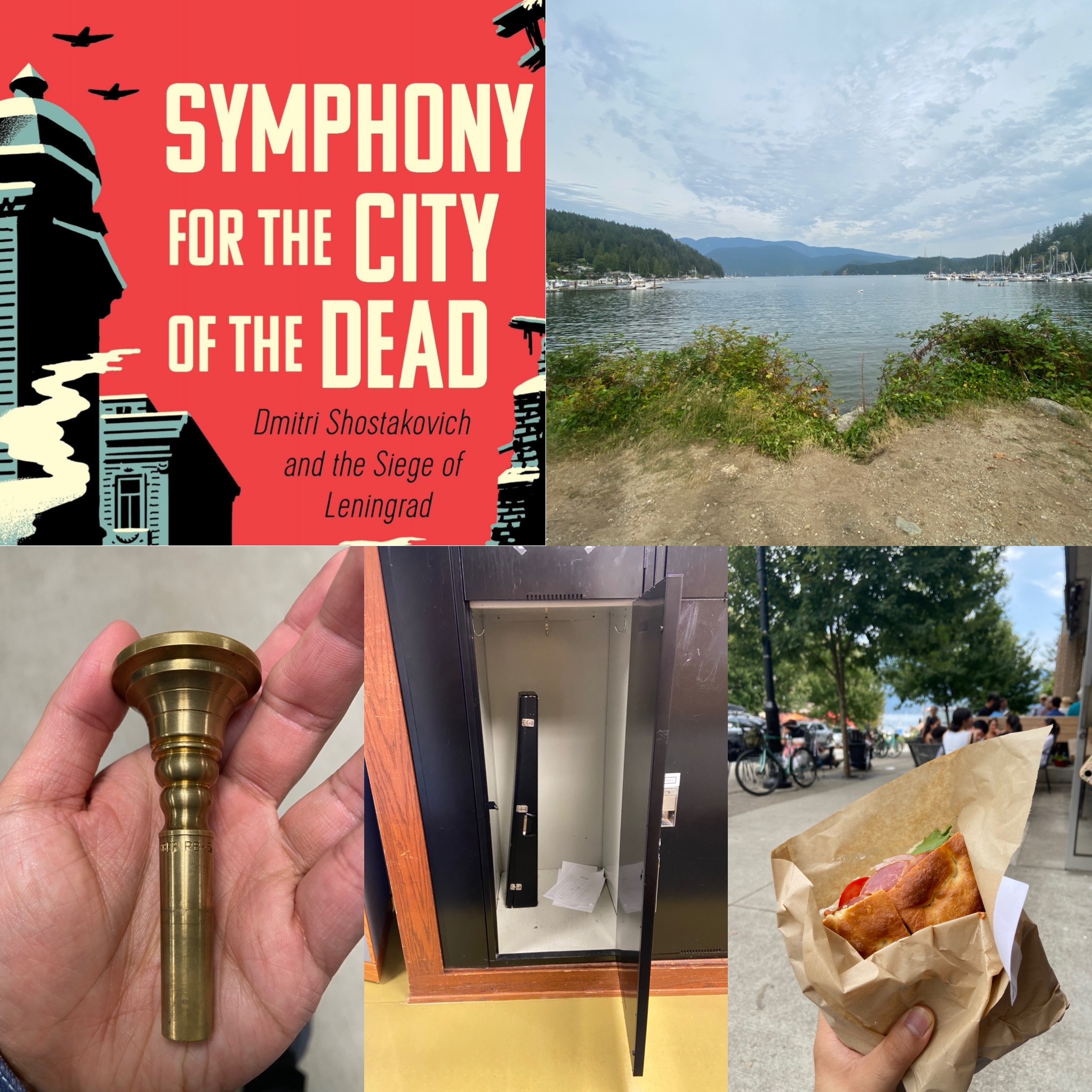
The 15th was the final day of the Renaissance Music Summer School for instrumentalists, where we had a few more rehearsals and a lecture on types of Renaissance music before welcoming the vocalist workshop participants with a concert. While I think I could’ve played better overall, my sound was remarkably firmer during the entirety of this day, and not just because of what I learned during this workshop. After borrowing a slightly modernized sackbut mouthpiece from Catherine Motuz, which was produced by Switzerland’s Egger and had a deeper cup, my sound became a lot more focused. Unfortunately, I had to return this miracle mouthpiece by the end of the day, but I noted its make down in case I wanted to buy it in the future. All in all, the Renaissance Music Summer School was a fun and insightful learning experience for me, and I can’t thank organizer Greg Skidmore and special guest Catherine Motuz enough for making it a reality.
I returned my bass sackbut to its UBC locker on the 20th, which will likely be my final time there for a long while, seeing as I depart Vancouver in just a few short days. Still, I didn’t really do anything special there apart from take one last walk through the Music Building. Since I didn’t really expect to participate in the summer school or work as EMV’s summer production assistant, I already bade my farewells with UBC all the way back in May during the graduation ceremonies, so being able to head back one more time by chance was just a nice (if not necessary) bonus.
Thanks for all the memories, UBC and the School of Music. It’s been a wonderful four years!
For the same reason I spent an extra little time at UBC, I headed to Deep Cove on the 21st, one of my favourite ‘hideaways’ in the Vancouver area. Apart from having a final opportunity to take in the cozy cove that captivated me ever since I first went there, and in an area that really encapsulates British Columbia’s beauty, I also got the chance to finally eat one of Dip Co.’s sandwiches, which was just as tasty as the long line outside it suggested. For my order, I went with the Spicy Fabulousa, which was mainly comprised of spicy capicola, eggplant salad (which is a better idea than you’d assume from the name), and a creamy ricotta cheese spread, which made for an explosion of spice and deliciousness with every bite. While this was slightly pricier than my normal sandwich orders, it was still well worth the cost.
Incidentally, Deep Cove is also where Remarkably Bright Creatures, one of my favourite movies of the year, was shot. Is this a teaser for a new section coming soon? Stay tuned to find out!
Practice Room
During summer school rehearsal on the 15th, a fellow participant noticed that the way I was gripping my bass sackbut in a way that would eventually sever a nerve in my thumb, since I was latching it onto the bell brace. This wasn’t a problem I previously noticed since I usually held my bass sackbut for around an hour at a time, but three days of non-stop sackbut playing were starting to make my thumb numb. Thankfully, Catherine Motuz showed me an alternative grip which put my thumb on the mouthpiece’s rim instead, which dramatically reduced my thumb strain in time for the concert that evening. One unfortunate side effect of shifting my grip this soon before a show was that I had to ‘relearn’ how to detach and reattach my outer slide to pour water out, since my hands were in a different position, but I ultimately managed to figure out a way to do so just in time.
Unfortunately, adapting back to modern trombone playing took me longer than I expected, especially since I was incorporating all the advice I received at summer school. This left me rather short of breath during my practice session on the 17th, and couldn’t really sustain high or long notes very well. Thankfully, these problems mostly went away once I got back into the swing of things on the 18th, and I even had a much firmer sound and embouchure to show for it. At this rate, I wouldn’t be surprised if I manage to make even more improvement on my weak points over the next few days of practice.
(Side note: I’ve mainly been practicing material for Royal Northern auditions at the beginning of the school year. I’ll explain more about this in a later post.)
Reflections
This section will mainly contain things that don’t exactly fit in any other section, primarily retrospectives or general (if vague) ramblings on life. Expect it to pop up whenever there isn’t much in Life Update.
Even though this will be my last full week in Vancouver for quite some time, it’s been mostly composed of unremarkable days as I write this on the 19th. Perhaps this is my last taste of ‘normalcy’ (if that word means anything anymore) before I depart for my next journey, and I’d better savour it while it still exists for me. Because truth be told, I’ve lived a far more eventful life than I ever bargained for, sometimes by choice and sometimes not, so quiet moments like this sometimes feel like the calm before the storm. However, I think everything I’ve experienced, be it good or bad, has enriched me as a person in its own way, which is why I’ve learned to deal with the unknown, especially when it appears out of nowhere.
Surprisingly, two of the things that many people know me by - my presence in Vancouver and being a music student - arose as results of situations I didn’t expect. I won’t go into specifics here, but my current path in life isn’t one I anticipated taking, even as recently as five years ago. Still, despite the uphill battles I needed to fight because of my sudden pivot in their direction, I came out with a firmer purpose in life, though not without plenty of help, guidance, and support along the way. (Maybe this will be something I’ll expand upon in a future entry.)
If coming to Vancouver and becoming a music student were the challenges I needed to overcome at the previous stage in my life, then it looks like my next stage will be very much the same, just in a different country and in a far more intensive environment. The difference this time is that I have a clear idea of where I’m heading, seeing as I actively chose this path myself, which means I’ll also need to be more active in making the most of it.
Perhaps that’s why I’m secretly grateful for one last opportunity to charge my batteries.
Book Club
For this week’s Book Club, I’ll be taking a look at M.T. Anderson’s Symphony for the City of the Dead, which I finished around a month ago. While this book can be read as a biography of Dmitri Shostakovich (my favourite composer), it primarily focuses on his Seventh Symphony, also known as the Leningrad Symphony, and the circumstances that led to its composition and premieres amidst the Nazi invasion of the Soviet Union during the Second World War.
The role of music in society is a recurring theme in this book, and was something which the nascent Soviet Union used and abused to great effect, especially its power to inspire and evoke emotions in people. Nowhere can this be more clearly seen than how some of Shostakovich’s works, such as his Fourth Symphony and Lady Macbeth of Mtensk, were denounced by the Soviet government, when the experimental style of composition he composed them in was held up as an example of Communist futurism just a decade before. Replacing it during Stalin’s reign was ‘socialist realism’, a style of art that could be boiled down to ‘whatever Stalin liked at the moment’. Thankfully for Shostakovich’s career (and his life), his Fifth Symphony (also my favourite symphony) fit the bill, allowing him to live on and compose was was arguably his most influential work.
The Siege of Leningrad (now Saint Petersburg) was one of the most brutal sieges in modern history. Because of Soviet mismanagement, there were inadequate food supplies in the city during the blockade, forcing people to turn to drastic measures just to survive, up to and including cannibalism. While Shostakovich initially participated in the defence of Leningrad as a volunteer firefighter (there’s a rather famous photo of him in a firefighter’s outfit I’ll talk about later), he and his family were ultimately spared the worst of these horrors due to being evacuated at an opportune moment along with other Soviet artists. Nevertheless, his hometown being reduced to such a sorry state left a deep impression in Shostakovich’s mind, and the decision to dedicate the symphony he began composing around the siege’s beginning to Leningrad itself couldn’t be more fitting.
Since the score followed Shostakovich around during his evacuation from city to city, even briefly becoming lost on a train ride east, it was only natural that the Seventh Symphony’s first premiere was in Kuibyshev (now Samara), the city where Shostakovich and his family ended up along with other Soviet elites. However, the Leningrad Symphony’s most memorable performance was ultimately destined to be in its namesake city, as its orchestra’s musicians braved hunger and exhaustion to pull it off, even being supported by Red Army musicians who replaced conscripted orchestra members. The symphony’s Leningrad premiere was deemed so important to Soviet morale that an entire military operation was planned around it just to ensure its successful performance, which went rather smoothly considering all the factors working against it.
Combined with Shostakovich’s pre-existing fame, the circumstances of the Leningrad Symphony’s composition and premieres crated massive international demand for it. This was most prevalent in the US (at least within this book’s scope), where conductors scrambled to premiere it and Shostakovich was featured on the cover of TIME magazine in his fireman outfit (the first composer to receive this honour, in fact). The accompanying TIME article (which I also read as a companion piece to this book) also does its best to humanize Shostakovich for a US audience, painting him as a football-loving dad who has much in common with the article’s readers, which played a part in toning down the US’ staunch anti-communism/USSR stance for the time being.
One of the more interesting anecdotes about the Leningrad Symphony (which the book even opens with) was its score’s journey to the US, as a microfilm copy of it basically survived crossing all continents (except Australia/Oceania) before ending up in the US, only to nearly get thrown in the trash because its overseer took his eyes off it for a few moments. Thankfully, it was recovered at the last moment, and its US premiere was well-received.
While the book does mention Shostakovich’s post-Second World War life and career, those sections mainly act as an extended epilogue, and are told in less detail compared to the earlier ones. Even so, Symphony for the City of the Dead absolutely delivers on its promise to tell the story of Shostakovich’s Seventh Symphony, which it does in a way that not only highlights the brutality of Stalin’s Soviet Union, the Second World War, and the Siege of Leningrad, but how music served as the driving force for Shostakovich and the Soviet people to keep themselves alive through these unspeakable horrors. If there ever was a book that gives a reason why human beings need music in order to truly live life, this would be an extremely strong contender.